
What are SEO, AEO & GEO?
How Search is changing in the AI era, and what you can do to adapt.
by John Constantinides
Search is always evolving. But AI tools, for better or (probably mostly) worse, are shaking things up dramatically when it comes to how people search and find information online.
For years, having people find your website was primarily about ranking well on Google. Organizations focused on optimizing their website’s content, improving keyword rankings, and driving organic traffic through traditional SEO (Search Engine Optimization). The goal of SEO is to rank your website as highly as possible in the list of “ten blue links” on the first page of Google.
That foundation still matters, for now. But based on recent trends, things are evolving fast.
AI-powered search is leading users to expect immediate, direct answers. Rather than browsing websites for information, they increasingly rely on AI tools like ChatGPT, Gemini, and Perplexity to summarize information, compare options, and make decisions.
In many cases, users no longer browse through pages of links. The answer is delivered before they ever visit a website.
This shift is transforming how organizations need to think about online visibility.
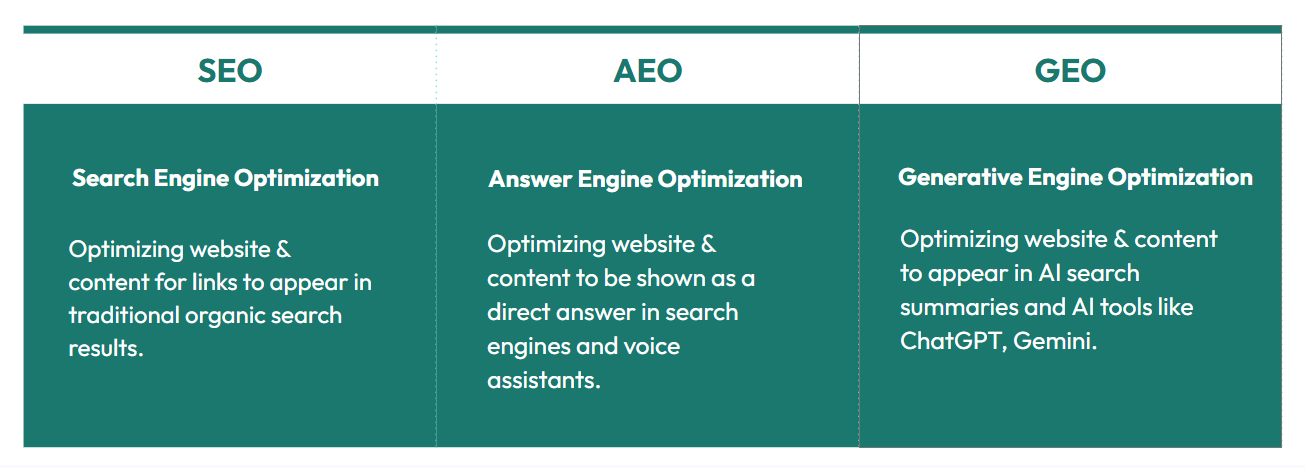
To respond to this shift, people who optimize websites have developed new specialized tactics to build on traditional SEO. These are referred to by the acronyms AEO and GEO.
AEO focuses on structuring content so it can be surfaced as a direct answer, whether it’s in voice assistants, “People also ask” results or rich snippets on Google.
Optimizing website content for AEO includes:
The goal is not only to generate clicks, but to ensure your organization becomes the trusted answer users see first.
GEO (Generative Engine Optimization) focuses on visibility within AI-generated responses and summaries.
AI tools like ChatGPT increasingly synthesize information from multiple sources to generate recommendations and answers. Organizations that produce clear, authoritative, well-structured content are more likely to be cited, referenced, or recommended by these systems.
In other words, visibility is no longer just about Google rankings. It’s about credibility, clarity, and trust.
This shift has important implications for organizations across sectors.
Users are searching differently:
Younger audiences, in particular, are rapidly adopting AI-assisted search behaviours. Instead of typing short keywords into a search engine, users now ask detailed questions, like: “I have a bachelor’s degree in English literature. Should I get an MBA? Which one would suit me the best? I live in Ontario but would be open to any Canadian university."
These types of queries are different from the standard keyword-based searches like “best online mba canada” that are the core of traditional SEO practices.
Organizations that rely solely on traditional SEO may gradually lose visibility as AI-generated answers become a larger part of the discovery process. They simply won’t appear in AI responses.
The good news is that the fundamentals of good content still matter.
Clear, useful, well-organized information performs better for both human users and AI systems.
You should focus on:
Technical optimization also remains important, including:
At the same time, organizations should think beyond traffic alone.
Increasingly, visibility happens before the click.
A prospective customer, student, or client may form an impression of your organization based on:
...before ever reaching your website.
How to Optimize Content for SEO - The Basics
How to Optimize Content - for AI Mentions
Traditional SEO is still a good foundation for optimizing your content and making your website search-friendly. But you also need to think about how your brand appears in answer engines and AI-generated experiences.
The organizations that adapt successfully will be the ones that:
Because increasingly, if you’re not part of the answer, you won’t be part of the decision.
Have a difficult communications problem? Reach out, we’re always happy to chat.